Medical Facility Cleaning Standards: Privacy, OSHA, and CDC Guidance

Key takeaway: Medical facility cleaning answers to three sources: the privacy and access rules your practice sets, OSHA's worker-safety rules for bloodborne-pathogen exposure and hazard communication, and CDC environmental infection-control guidance adopted into your facility's protocols. Before signing, verify a vendor's training, products, documentation, and written scope against all three, and confirm who performs each task in clinical areas.
What cleaning standards apply to medical facilities?
Healthcare facility cleaning combines three sets of responsibilities. The practice controls patient privacy, access, and the protocols for each area. OSHA regulates worker safety, including bloodborne-pathogen exposure and chemical hazards. CDC publishes environmental infection-control guidance that facilities adopt into their own procedures. The exact obligations depend on the written scope, the exposure-control plan that covers the crew, and the facility's policies, which is why healthcare cleaning starts with a walk-through that confirms them.
How does HIPAA apply to ordinary janitorial work?
HIPAA reaches a cleaning crew through the privacy and access rules the practice sets, not through a standard the vendor brings. The practice decides which areas the crew may enter and when, how records and personal items are to be treated, and who is notified when something is found exposed. Those rules are confirmed with the practice before the first visit and documented during onboarding. Whether a cleaning vendor needs a business-associate agreement is a question for the practice's compliance lead. Ordinary janitorial work generally does not create that relationship when any contact with patient information is incidental; a different analysis may apply when a vendor routinely handles records.
- Incidental exposure — Facility safeguards, such as locked document bins and cleaning scheduled around appointments, reduce the chance that cleaning staff encounter visible patient information.
- Scope matters — Routine record handling or document destruction can create different contractual and legal obligations.
- Facility rules — Assigned staff receive site-specific instructions for privacy, access, escalation, and incident reporting before working alone.
Practical behavior standard: Do not read, photograph, move, or discuss patient information. Stop work in the immediate area and notify the facility's authorized contact when patient information is left exposed. Keep personal phones secured during the shift. Handle document disposal only when the written scope and facility procedures expressly authorize it.
What OSHA standards apply to healthcare cleaning?
OSHA's Bloodborne Pathogens Standard (29 CFR 1910.1030) is the cornerstone regulation for workers whose tasks carry exposure risk. Key requirements:
- Exposure Control Plan — a written plan identifying tasks with exposure risk and the protective measures required for each
- Universal Precautions — treating all blood and bodily fluids as potentially infectious
- Personal Protective Equipment — gloves, gowns, and face protection appropriate to each task
- Hepatitis B vaccination — offered at no cost to employees with occupational exposure risk
- Post-exposure evaluation — medical follow-up after any exposure incident
- Annual training — documented refresher training for covered staff
Which tasks in a cleaning scope carry exposure risk is identified in the exposure-control plan that covers the crew, written against the facility's protocols, and the vendor's training is matched to it. Role-specific safety training is confirmed for the tasks, hazards, and facility requirements in scope. Spill-kit placement, responsibility, exposure escalation, and safe-access procedures are documented before service begins.
OSHA's Hazard Communication Standard (29 CFR 1910.1200) also applies: Safety Data Sheets for the cleaning products in use must be accessible, containers must be labeled, and employees must be trained on the chemical hazards they work with.
What does CDC guidance say about environmental cleaning?
CDC's environmental infection-control guidelines are the reference facilities adopt into their own protocols. For the cleaning program, the practical points are:
- Clean visibly soiled surfaces before applying disinfectant.
- Use EPA-registered disinfectants and follow the label's contact (dwell) time, so the surface stays wet for the required duration.
- Give high-touch surfaces their own place in the task list, with the practice deciding which surfaces belong there.
- Use equipment and cloths in a way that does not carry soil from one area into another.
EPA-registered products and label directions
Products are selected for the surfaces the facility approves and used according to label directions. For each disinfectant in use, verify the EPA registration number on the label, the surfaces it is approved for, the contact time, and the Safety Data Sheet; other cleaning products carry no registration number, so the Safety Data Sheet is the record for them. The product list with registration numbers is one of the records the practice should keep.
Who cleans what in a medical office?
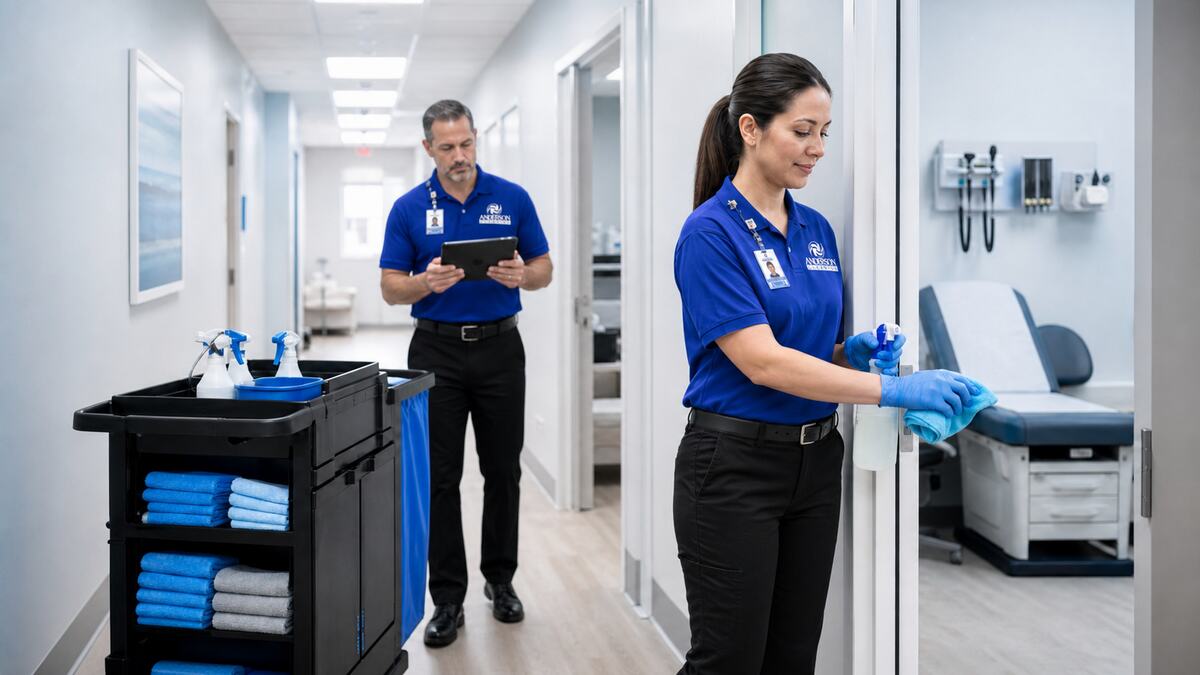
The written task list decides. If clinical staff handle between-patient wipe-downs of exam surfaces and equipment under the practice's own protocol, the cleaning program covers the scheduled routine for exam rooms, waiting areas, restrooms, and staff spaces, with a task and a cadence for each. If the practice wants the cleaning program to cover more, that is written into the scope. Either way the line is recorded, so nothing is assumed to be covered that is not.
Each area gets its own documented specification rather than a general office checklist. The specification names the surfaces in each room, the tasks performed on them, how often, and the approved product for each, and it lists what is excluded.
What documentation supports surveys and inspections?
Environmental-cleaning documentation may be reviewed during accreditation and state surveys, so the records belong in the facility's file rather than in the vendor's system alone. Documentation is provided when included in the agreed service plan. Typical records are digital inspection logs signed by the site supervisor, quality-review records on the agreed schedule, the product list with EPA registration numbers, access logs, and the written task list itself. The documentation post covers who signs each record and how long to keep it.
What training should healthcare cleaning staff have?
At minimum, staff assigned to a medical office should have:
- OSHA Bloodborne Pathogens training, with the annual refresher the standard requires, for staff whose tasks carry exposure risk
- Hazard Communication training on the products in use
- Facility-specific privacy, access, and escalation instruction before working alone
- Infection-control fundamentals, including hand hygiene and the use of protective equipment
- Site-specific orientation covering your protocols and who to contact
Training is documented, and the records are available for the facility's file when the service plan includes them.
What should you verify before signing?
Verify four things in writing: the training the assigned staff have for the tasks in your scope, the product list with registration numbers and Safety Data Sheets, the records you will receive and how often, and the written scope with its exclusions. The questions to ask a healthcare cleaning vendor put these into a form you can send to any bidder.
Partner with a healthcare cleaning specialist
Anderson Cleaning provides site-specific recurring service for outpatient healthcare facilities across Western Massachusetts and approved Northern Connecticut communities. Screening, training, access, product, and documentation requirements are confirmed for each assignment.
The facility walkthrough defines included areas, privacy and exposure-control expectations, approved products, service frequencies, escalation contacts, and any records included in the service plan. Anderson does not provide regulated medical-waste disposal, sharps handling, biohazard remediation, or cleanroom services.
Schedule a healthcare-specific walkthrough — best fit for ongoing service relationships.
Sources
Need Professional Cleaning Services?
We handle critical cleaning for offices, healthcare facilities, and life sciences environments across Western MA and Northern CT. Get a custom proposal built for your facility.
Request Proposal