Restroom Inspection and Stocking Best Practices for Commercial Facilities

Key takeaway: Consistent restrooms come from structure: a defined inspection cadence, a stocking protocol with agreed reorder points, and a log that records who checked what and when. Most restroom complaints trace to a missing routine, not a lack of effort.
Why Restrooms Define Facility Perception
Restrooms are the single most inspected space in any commercial facility. Building occupants, patients, visitors, and prospective tenants form lasting impressions based on restroom condition. A clean, well-stocked restroom signals that the facility is professionally managed. A neglected one raises questions about every other aspect of building operations.
Despite this, restroom management is one of the most common sources of facility complaints. The root cause is rarely a lack of effort — it is a lack of structure. Without a defined inspection cadence, stocking protocol, and accountability system, restroom quality becomes inconsistent and reactive.
Establishing Inspection Frequency
Inspection frequency should be based on facility type, occupant count, and traffic patterns. There is no universal standard, but the following guidelines provide a practical starting point:
- Healthcare facilities (clinics, medical offices): Every 60 to 90 minutes during operating hours. Patient-facing restrooms require frequent attention due to infection control standards and patient experience expectations.
- Corporate offices (50-200 occupants): Two to three times per day, with at least one mid-morning and one mid-afternoon check. Higher-traffic floors may need more frequent attention.
- Multi-tenant commercial buildings: Common-area restrooms should be inspected every 90 to 120 minutes. Tenant-specific restrooms follow the tenant's cleaning specification.
- High-traffic public-facing facilities: Every 30 to 60 minutes during peak hours. Facilities with continuous visitor flow — such as event venues or large medical campuses — may require near-continuous porter coverage.
The key is to establish a documented schedule and hold the cleaning team accountable to it, rather than relying on ad-hoc checks.
Designing an Effective Check Sheet
A restroom inspection check sheet should be simple enough to complete in two to three minutes but comprehensive enough to catch developing issues. Effective check sheets include the following elements:
- Date, time, and inspector initials — Basic accountability fields that create a verifiable record
- Supply levels — Toilet paper, hand towels or dryer status, soap dispensers, seat covers (if provided), and feminine hygiene products
- Fixture condition — Toilets flushing properly, faucets operating, no leaks or clogs
- Floor condition — Dry, clean, free of debris and standing water
- Odor assessment — Neutral or acceptable (this is subjective but important to document)
- Mirror and partition condition — Clean, free of graffiti or damage
- Trash receptacle status — Not overflowing, liner intact
Many facilities mount the check sheet on the back of the restroom door or inside a wall-mounted holder. This makes the inspection visible to occupants, which itself serves as a quality signal.
Setting Stocking Par Levels
Running out of supplies is the fastest way to generate complaints. Par levels — the minimum quantity of each supply item that should be present at all times — prevent stockouts and reduce the need for emergency restocking runs.
Par levels should be set based on observed consumption rates, not guesswork. Track usage over a two- to four-week period to establish baseline consumption, then set par levels at 150 percent of the average daily use to provide a buffer.
Common stocking items and typical par-level considerations:
- Toilet paper: At least two full rolls per stall at all times, with backup stock in the restroom storage area
- Hand towels: Dispensers should be refilled before reaching 25 percent capacity
- Soap dispensers: Refill when below one-third full; empty soap dispensers are a top complaint trigger
- Seat covers: If provided, maintain a full dispenser at all times
- Trash liners: Replace at every inspection if the bag is more than two-thirds full
Addressing Common Complaints and Root Causes
Most restroom complaints fall into a few predictable categories. Understanding the root causes allows facility managers to address them systemically rather than reactively.
"The restroom smells." Odor is usually caused by one of three things: infrequent floor mopping (urine and moisture accumulate in grout lines and around fixtures), a malfunctioning exhaust fan, or a dry floor drain P-trap. Floor drains that are not regularly flushed allow sewer gas to escape into the space. Running water down floor drains weekly prevents this.
"There is never soap/paper towels." This is a stocking cadence issue. If supplies run out between inspections, the inspection frequency or par levels need to be adjusted. It may also indicate a dispenser malfunction — jammed dispensers are a common cause of apparent stockouts.
"The floor is always wet." Wet floors near sinks are often caused by splash-back from poorly adjusted faucet aerators or by occupants shaking water from their hands before reaching the towel dispenser. Placing a small absorbent mat near the sink area can mitigate this. Persistent wet floors elsewhere may indicate a plumbing leak that requires maintenance attention.
"The restroom looks dirty even after cleaning." This usually indicates that cleaning is happening but not thoroughly enough. Grout lines, fixture bases, partition hardware, and the areas behind toilets are commonly missed during rushed cleanings. A detailed cleaning specification — not just "clean the restroom" — ensures nothing is skipped.
Fixture Maintenance and Odor Control
Restroom fixtures require periodic maintenance beyond daily cleaning. Flush valves, faucet aerators, and drain assemblies should be inspected monthly for proper function. Caulking around fixtures should be checked quarterly and re-applied as needed to prevent moisture infiltration.
For odor control, avoid relying solely on air fresheners. Air fresheners mask odors rather than eliminating them. Effective odor control requires:
- Thorough floor mopping with an enzymatic or bio-enzymatic cleaner that breaks down organic matter in grout lines
- Regular drain maintenance (flush floor drains weekly, treat with enzyme drain cleaner monthly)
- Functional exhaust ventilation (verify that exhaust fans are operating during all occupied hours)
ADA Compliance Considerations
Restroom inspections should also verify ongoing ADA compliance. Accessible stalls must remain clear of stored supplies, cleaning equipment, or other obstructions. Grab bars must be secure. Soap and towel dispensers must be mounted at accessible heights. Automatic flush and faucet sensors should be tested for reliable operation.
While ADA compliance is a building management responsibility, the cleaning team is often the first to notice when something is out of place. Including ADA compliance checkpoints on the inspection form creates an additional layer of vigilance.
How Professional Cleaning Partners Handle Restroom Programs
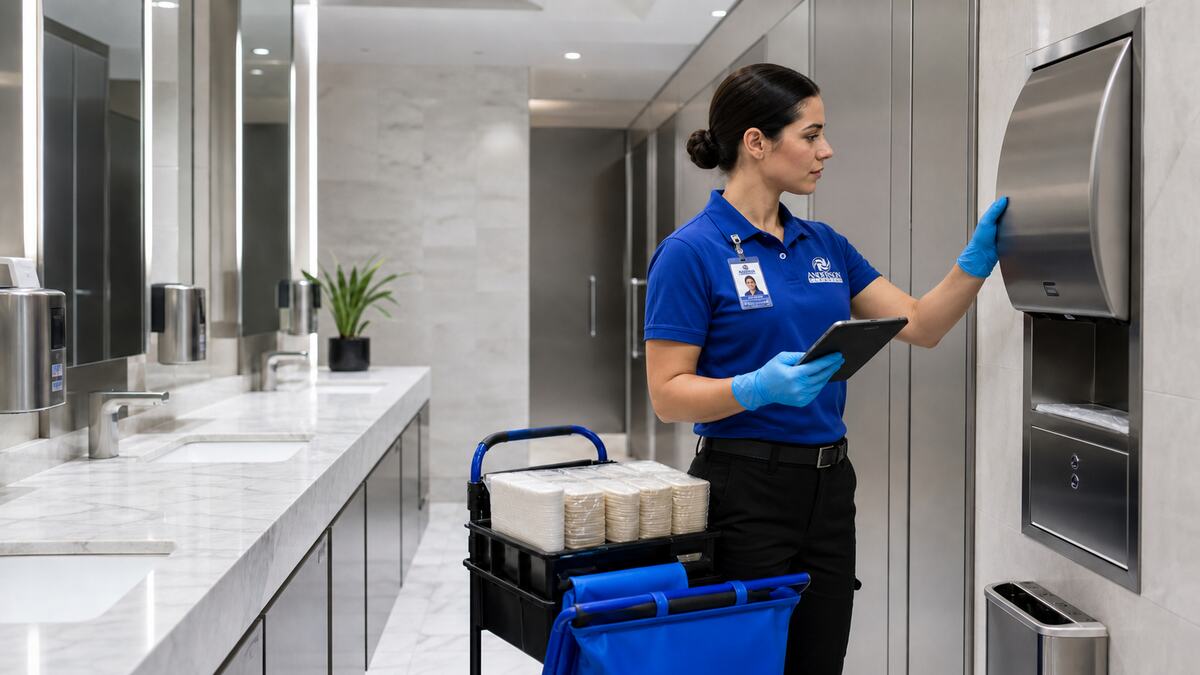
A professional cleaning partner should bring structure, documentation, and accountability to restroom management. Anderson Cleaning's restroom programs include defined inspection cadences, documented check sheets, supply par-level management, and regular quality reviews with the facility manager.
The goal is to eliminate restroom complaints by preventing the conditions that cause them — not by reacting after occupants have already had a negative experience. A well-managed restroom program is invisible to building occupants, and that invisibility is the highest standard of success.
Sources
Need Professional Cleaning Services?
We handle critical cleaning for offices, healthcare facilities, and life sciences environments across Western MA and Northern CT. Get a custom proposal built for your facility.
Request Proposal