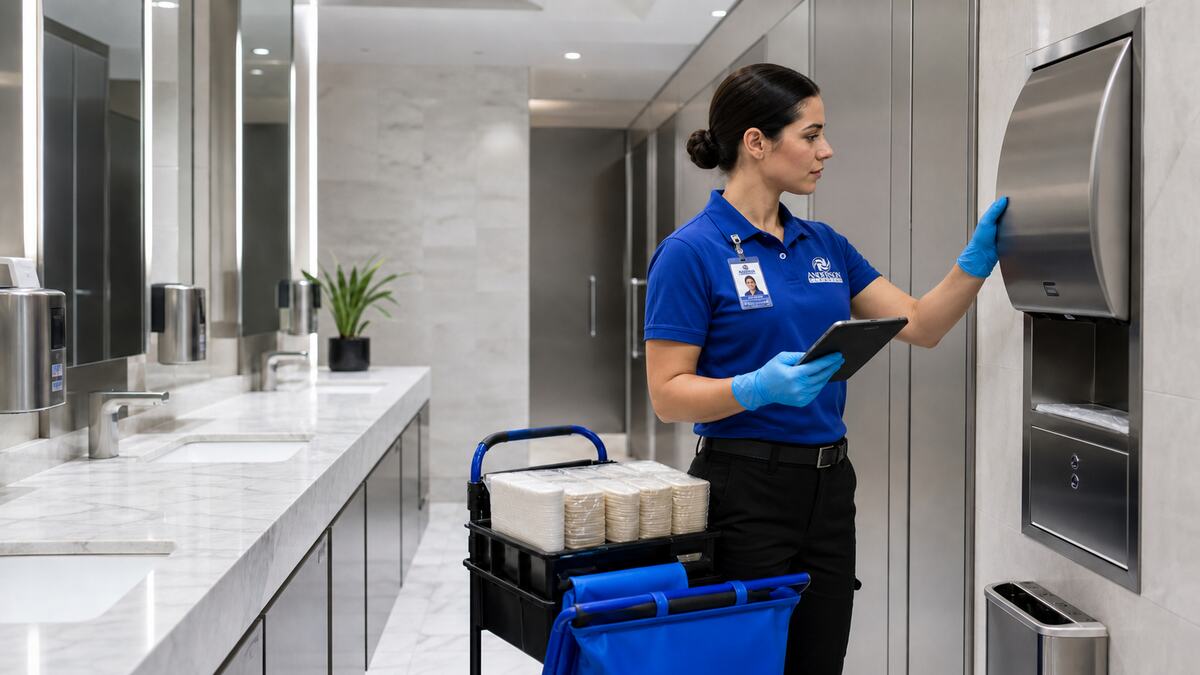
What to Expect From a Commercial Cleaning Partner


Key takeaway: A professional cleaning partner provides a structured onboarding with a walk-through and written scope, a consistent crew with a dedicated site supervisor, clear communication and escalation, and documented quality reviews on an agreed schedule. Price alone predicts very little about how the relationship will go.
Beyond the Bid: What a Cleaning Partnership Should Look Like
Hiring a commercial cleaning company is one of the most consequential vendor decisions a facility manager makes. The cleaning partner touches every surface in the building, operates during sensitive hours, interacts with building occupants, and directly shapes the perception of facility quality. Yet many organizations treat the selection process as a simple price comparison, which often leads to mismatched expectations and disappointing results.
A professional cleaning relationship should function as a genuine partnership, with clear communication, defined accountability, and mutual commitment to the facility's standards. Understanding what to expect — and what to demand — helps facility managers evaluate providers effectively and build relationships that last.
The Onboarding Process
A professional cleaning provider should have a structured onboarding process that goes beyond handing a crew a set of keys. Effective onboarding includes:
- Site walkthrough with the facility manager — The provider should walk every space in the facility with the client to document cleaning specifications, identify high-priority areas, note any restrictions or special requirements, and agree on access protocols.
- Written scope of work — The cleaning specification should be documented in writing, detailing what tasks are performed daily, weekly, monthly, and quarterly. Ambiguity in scope is the leading cause of service disputes.
- Crew introduction — The facility manager should know who will be cleaning the building. A brief introduction, even informal, establishes a working relationship and accountability.
- Emergency and communication protocols — Who does the facility manager contact if there is an issue? What is the escalation path? How are after-hours emergencies handled? These details should be established before service begins, not figured out during a crisis.
Providers that skip or rush onboarding are signaling that they treat cleaning as a commodity rather than a service relationship.
Dedicated Teams vs. Rotating Crews
One of the most important questions a facility manager should ask a prospective cleaning provider is whether the facility will be served by a dedicated team or a rotating pool of workers.
Dedicated teams — where the same individuals clean the same facility on a consistent basis — offer significant advantages. Crew members learn the building's layout, understand the facility manager's priorities, and develop familiarity with building-specific equipment and access requirements. Dedicated teams are also easier to hold accountable because the same people are responsible for the same spaces every day.
Rotating crews — where different workers are assigned to the facility on different nights — introduce variability. New crew members may not know where supplies are stored, which areas require special attention, or what the facility manager's expectations are. Rotating crews often result in inconsistent quality and more frequent complaints.
Professional cleaning providers that prioritize quality typically assign dedicated teams and have protocols for coverage when a regular team member is absent. Anderson Cleaning assigns dedicated crews to each facility and provides a site supervisor as the single point of accountability.
Communication Expectations
Clear, consistent communication is a hallmark of a professional cleaning partnership. Facility managers should expect:
- A dedicated point of contact — Not a general call center or rotating account managers. A single individual who knows the facility and its history.
- Defined communication channels — Whether updates are delivered via email, a shared platform, or in-person meetings, the method should be agreed upon and consistent.
- Proactive issue reporting — The cleaning team should report maintenance issues they encounter (leaking faucets, damaged ceiling tiles, burnt-out lights) without being asked. This "eyes on the building" function adds significant value beyond cleaning.
- Responsiveness — Messages and requests should receive acknowledgment on a timeline appropriate to their urgency, with a clear escalation path for urgent concerns.
If communication feels one-sided — where the facility manager is always the one initiating contact — the partnership is not functioning as it should.
Documentation and Reporting
Professional cleaning providers document their work. This documentation serves multiple purposes: it verifies that contracted tasks were performed, provides a record for compliance audits, and creates a basis for quality discussions.
Facility managers should expect:
- Inspection logs — Records of completed cleaning tasks, often signed or digitally timestamped
- Quality audit reports — Summaries of inspection results on the schedule agreed in the service plan
- Supply usage reports — If the provider manages supplies, consumption data should be shared regularly
- Incident reports — Documentation of any unusual events, damage, or security concerns encountered during cleaning
Providers that resist documentation or claim it is unnecessary are often providers that cannot demonstrate consistent quality.
Quality Assurance Walkthroughs
Regular quality assurance walkthroughs — where the cleaning provider's supervisor walks the facility with the facility manager — are one of the most effective tools for maintaining service standards.
These walkthroughs happen on the schedule agreed in the service plan, set during onboarding and adjustable at any review. During the walkthrough, both parties review cleaning quality, discuss any concerns, and agree on adjustments to the scope or schedule as needed.
Walkthroughs are not adversarial. They are collaborative check-ins that keep both parties aligned and prevent small issues from becoming large disputes.
Scope Changes and Flexibility
Facility needs change. Tenants move in or out. Seasonal events create temporary spikes in cleaning demand. Renovation projects generate dust and debris. A good cleaning partner accommodates these changes with clear communication about scope adjustments and cost implications.
Facility managers should expect:
- A defined process for requesting scope changes
- Transparent pricing for additional services
- Willingness to adjust staffing or schedules for temporary needs
- No penalty for reasonable scope reductions if facility needs change
Rigidity is a red flag. A cleaning provider that cannot adapt to changing facility conditions is not built for partnership.
Contract Transparency
The cleaning contract should be clear, fair, and free of hidden provisions. Facility managers should review contracts carefully for:
- Auto-renewal clauses — Understand when and how the contract renews, and what the cancellation notice period is
- Price escalation terms — If the provider can increase pricing, under what conditions and with what notice?
- Termination provisions — What happens if the relationship is not working? Is there a cure period for performance issues before termination is allowed?
- Insurance and liability — The provider should carry general liability, workers compensation, and property damage insurance. Certificates should be provided before service begins.
Red Flags to Watch For
Experienced facility managers learn to recognize warning signs during the evaluation process:
- The provider cannot clearly explain the onboarding process
- No site walkthrough is conducted before pricing is provided
- The bid is significantly lower than all competitors (often a sign of corner-cutting or bait-and-switch)
- No references are available from facilities of similar size and type
- The provider is unwilling to commit to dedicated crews
- Documentation and quality assurance processes are vague or nonexistent
Selecting a cleaning partner based solely on price almost always results in a cycle of hiring, frustration, and replacement. Evaluating providers on process, communication, and accountability — in addition to cost — leads to partnerships that deliver consistent value over time.
Anderson Cleaning structures every client relationship around these principles: dedicated teams, documented specifications, regular quality reviews, and transparent communication. The goal is not just a clean building, but a partnership that makes the facility manager's job easier.
Sources
Need Professional Cleaning Services?
We handle critical cleaning for offices, healthcare facilities, and life sciences environments across Western MA and Northern CT. Get a custom proposal built for your facility.
Request Proposal