How Life-Sciences Support Spaces Are Cleaned: Lab Floors, Gowning Areas, and Corridors

Key takeaway: Life-sciences support spaces are cleaned by zone, not to one office standard. Lab floors, manufacturing floors, gowning areas, and corridors each get a written protocol that fixes the products the facility has approved, the dust-control methods, the order of work, and the hours the crew may be there. ISO-classified cleanrooms, hazardous waste, and chemical spill response sit outside that scope and belong to specialized providers.
What counts as a life-sciences support space?
A support space is one of the areas named in Anderson Cleaning's published life-sciences scope. On the lab side those are lab floors, manufacturing floors, gowning areas, and the corridors that connect them. On the office side they are the administrative suites, conference rooms, lobbies, break rooms, and restrooms that sit in the same building.
The distinction matters because the two halves of the building are cleaned to different protocols, and because the boundary is written into the proposal. Anderson Cleaning cleans the support areas; ISO-classified cleanrooms, hazardous waste, and chemical spill response require specialized providers. The life sciences page states that scope, and every site proposal repeats it.
How does support-space cleaning differ from office cleaning?
Three things change: the products, the dust-control methods, and the timing. In an office, the crew uses the provider's standard product set and works through a per-visit task list after hours. In a lab-support zone, the facility's quality system decides which products may be used on which surfaces, how dust is controlled so it does not travel toward the lab, and when the crew may be in each area.
The practical result is a zone map. Each area is assigned a zone with its own protocol, so lab-support and office spaces are not cleaned to one generic standard. The zone map is confirmed on the walk-through before service starts, and the site supervisor inspects against it on each round.
How are cleaning products approved for a lab-support zone?
The facility approves them, not the cleaning vendor. Before service begins, the provider submits the product list it proposes for each zone, with safety data sheets, and the facility's quality or environmental health and safety lead confirms what is allowed on each surface. Some surfaces carry a restriction, such as a sealed floor that cannot take an alkaline stripper or a stainless gowning-room bench that needs a specific wipe. In a lab-floor zone the crew's work is dust mitigation, trash removal on its defined route, floor care, and the surfaces the protocol names; anything the protocol does not name stays with the facility's own staff.
Where the facility calls for a disinfection step, the crew uses EPA-registered disinfectants from the approved list, applied according to label directions including the contact time the label specifies. Product changes go through the same approval, in writing, rather than appearing on the cart one night. The disinfection services page describes how products and surfaces are written into the specification.
What does dust control look like on a lab floor?
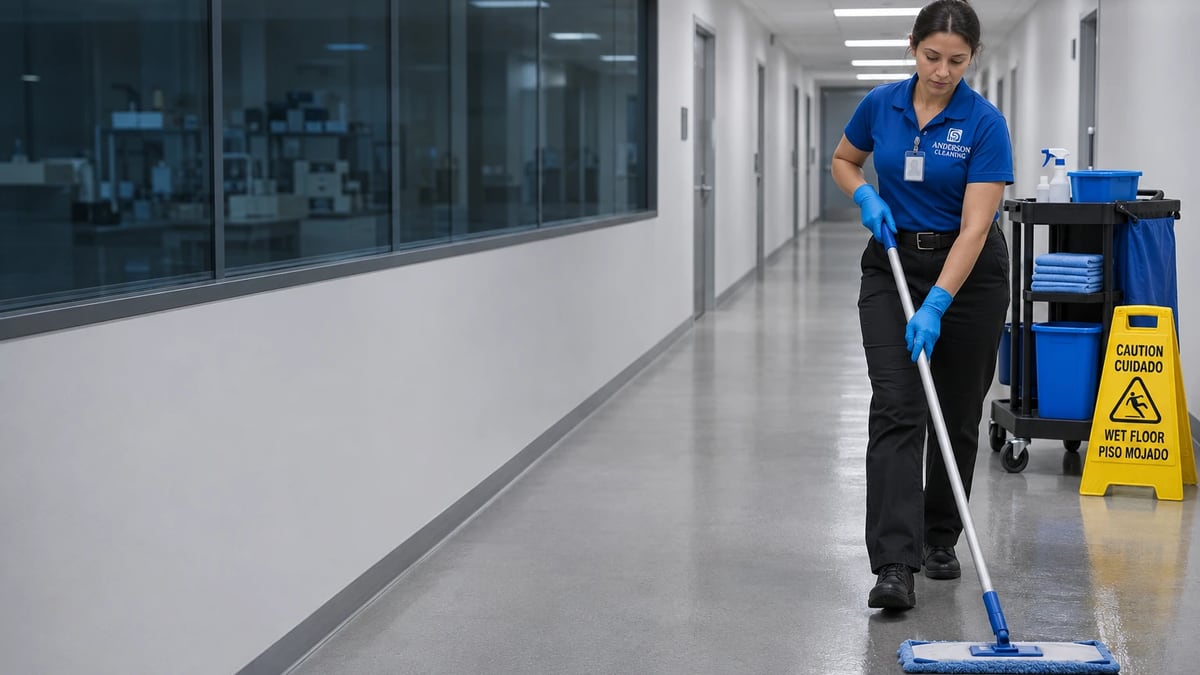
Dust control means moving dust toward the exit, not into the lab. The crew works from the cleanest zone toward the least clean, uses damp methods and microfiber rather than dry sweeping or feather dusting, and changes cloths and mop heads between zones so nothing is carried from a corridor onto a lab floor. Trash leaves on a defined route, bagged and closed, and the crew does not open waste streams the facility has designated for its own handling.
Floor care follows the same logic. Sealed resilient and polished concrete floors are common in lab-support areas, and the floor care page covers how they are maintained. On a lab floor, the finish products and the machine work are scheduled through the zone protocol, usually in a window when the area is idle and with the dust-containment steps the facility asks for.
How are gowning areas cleaned?
A gowning area is cleaned at a time the facility sets, usually when no one is gowning, in a fixed order that ends with the floor. The crew follows the facility's entry rule for that room (hair covers, shoe covers, or a frock where the SOP calls for them) and uses tools and a mop head kept for that room rather than the corridor cart. The order is high surfaces and dispensers first, then benches, lockers, and bins, then the floor last so nothing settles on it afterward. Lint and paper fragments are the usual problem, so the floor is damp-mopped rather than swept, and liners are replaced rather than emptied and reused.
The crew does not pass through the gowning area into a classified space. Where a gowning room opens onto a cleanroom, the cleaning scope stops at the gowning side of that door, and the protocol says so. The facility's own classification of each room is confirmed on the walk-through and recorded on the zone map, so the published boundary (ISO-classified spaces require specialized providers) is applied room by room rather than assumed.
How do traffic patterns change the schedule?
Corridors between lab and office areas carry both foot traffic and cart traffic, so they are cleaned on a different rhythm from the lab floors they connect. Many sites pair daytime coverage in high-traffic corridors, restrooms, and break areas with an after-hours routine for lab floors and manufacturing floors on an agreed window. The day porter page describes the daytime model; the recurring janitorial routine covers the evening work.
Access rules shape the schedule as much as traffic does. Each zone's protocol records who may enter it, whether entry is logged, and what the crew does if it finds a door it expects to be locked standing open. Those rules are confirmed before service, and new crew members receive site-specific instruction on them before they work alone.
Where is the boundary with cleanroom scope?
At the classified door. Support-area cleaning covers lab floors, manufacturing floors, gowning areas, and corridors, plus the administrative side of the building. ISO-classified cleanrooms, hazardous waste, and chemical spill response require specialized providers, and that boundary is written into every proposal. A facility that needs both engages two providers, and the zone map shows where one scope ends and the other begins.
What should a quality lead ask a cleaning vendor?
Four questions settle most of it. Can you show the zone map and the protocol for each zone? Which products do you propose for each surface, with safety data sheets? What does the inspection log record, who signs it, and how often will we see it? Who is the named site supervisor, and how do they escalate an issue? A vendor who answers all four in writing is proposing a program that fits a quality system. One who answers with a general task list is proposing office cleaning in a lab building.
Anderson Cleaning starts life-sciences work with a walk-through of the support areas and a review of the facility's SOP requirements, then sends a written proposal with the zone map, products, frequencies, and documentation. Schedule a walk-through and we will map your zones with you.
Sources
Need Professional Cleaning Services?
We handle critical cleaning for offices, healthcare facilities, and life sciences environments across Western MA and Northern CT. Get a custom proposal built for your facility.
Request Proposal