Entryway Matting and Floor Protection Before Winter


Key takeaway: Prepare entrances in October, before the first salt, while floors are dry and finish work can cure. Check every entrance for the mat zones it has room for, replace mats with worn pile or curling edges, set a rotation so saturated mats can be swapped and dried, walk entry floors for finish wear, and book the fall scrub-and-recoat now. Write the winter routine into the cleaning scope.
Why does entryway preparation start in October?
Entryway preparation starts in October because the protection has to be in place before the first salt, and most of it takes lead time. Replacement mats need to be measured and ordered. A scrub-and-recoat or a full strip needs an after-hours window and cure time before heavy traffic returns. The winter routine needs to be agreed with the cleaning vendor and, often, the snow contractor and property manager.
October is also when the building is fully occupied again, so the traffic you see now is what the entrances will carry all winter. What follows is the checklist to work through this month.
Which entrances need walk-off matting?
Every door people use needs walk-off matting, not only the main lobby. Walk the building and list the staff entrance, the door from the parking lot, the loading or delivery door, and any elevator lobby that opens from a garage. Side entrances are the ones most often left with a single thin mat.
At each entrance, plan for three zones: a coarse scraper mat outside the door, an absorbent mat in the vestibule, and a low-profile wiper mat inside. Each zone should be long enough that a person takes several full steps on it, and mats should match the door width so traffic cannot walk around them. A door with no vestibule gets the scraper mat outside and the longest wiper mat that fits inside. The winter floor care post covers how each zone works once the salt arrives; the October job is making sure the zones exist.
How do you check the mats you already have?
Pull each mat, turn it over, and look at four things. Pile that is crushed flat or worn through will no longer scrape or absorb. Edges that curl or backing that has cracked create a trip hazard and let water underneath. A mat that has shrunk or stretched so it no longer lies flat will migrate under traffic. And a mat that is narrower than the door will be bypassed.
Then check that the floor under each mat is dry and sound; moisture trapped under a mat all winter can cloud finish or lift tile edges. Replace what fails, and record each mat's size and type so reorders are simple.
What is a mat rotation and cleaning plan?
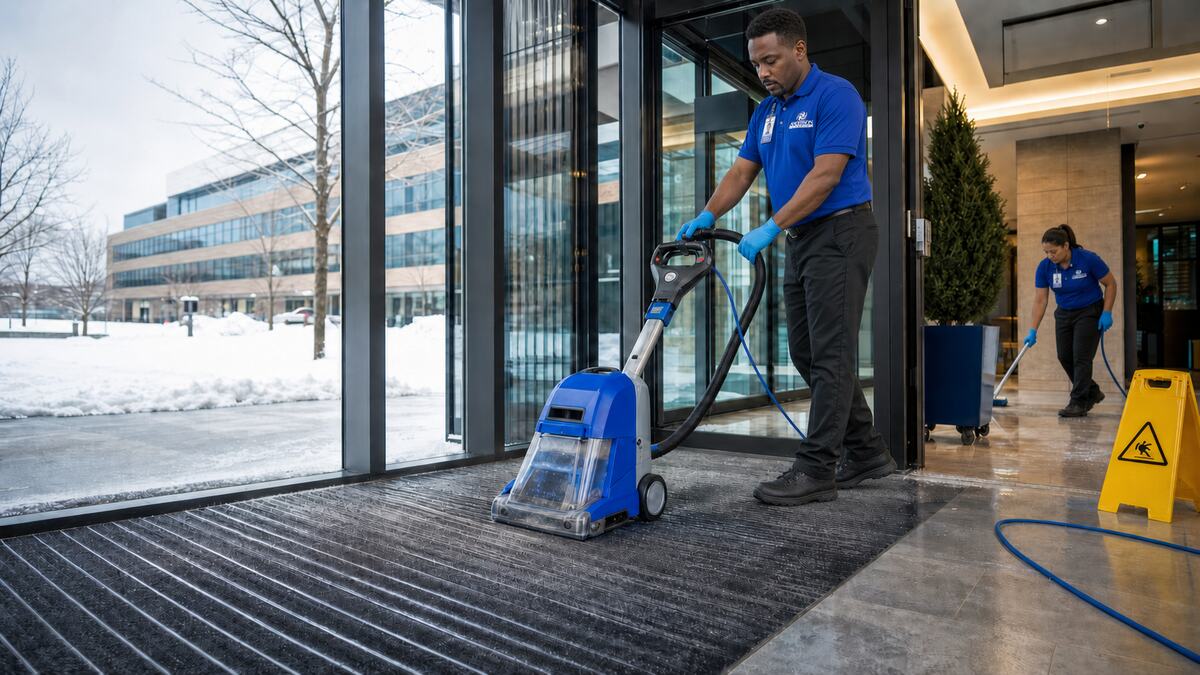
A rotation plan means having enough mats that a saturated one can be swapped for a dry one and hung to dry rather than left down. A wet mat captures nothing and becomes a source of the moisture and salt it was meant to stop. Decide first whether the mats are owned by the building or supplied by a mat-rental service. Rented mats are swapped and laundered on the service's route, and that schedule belongs in the plan so extraction and the swap do not double up or leave a gap; owned mats need a spare set on site so a wet one can be pulled and dried.
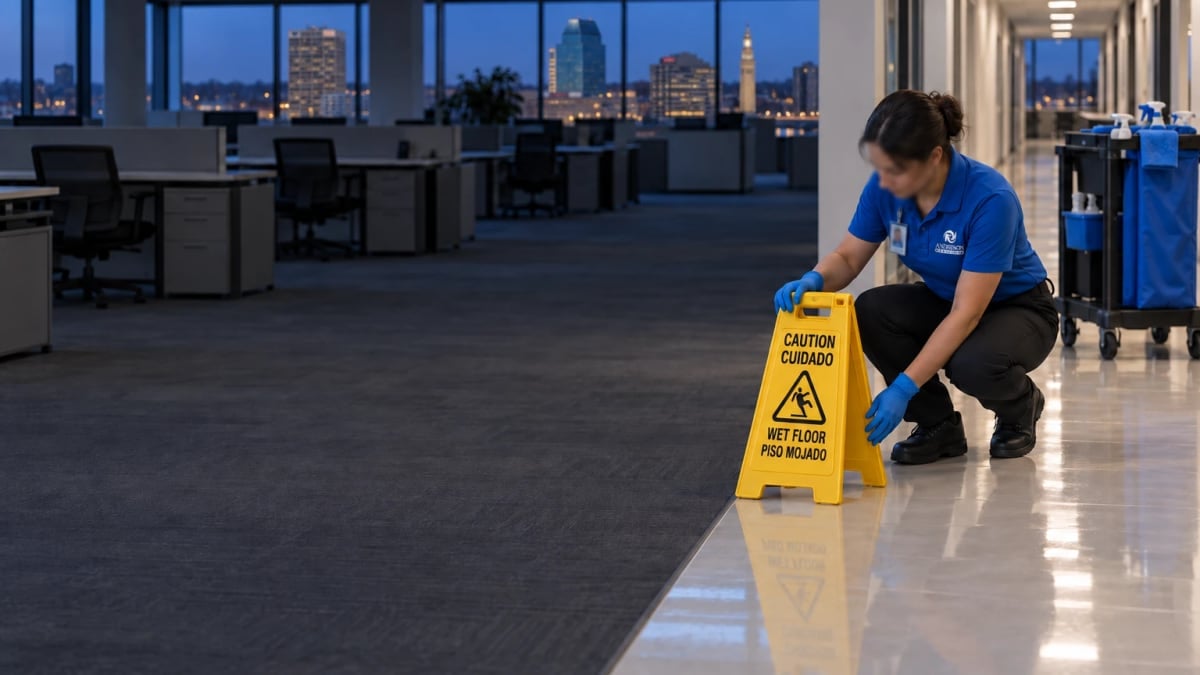
Decide now who does that work. In a building with day porter coverage, the porter can swap and extract mats during business hours and keep the vestibule floor mopped, with wet-floor signs out and a dry path kept open. The evening crew vacuums the mats, extracts them on the agreed schedule or when they are saturated, cleans and dries the floor under them, and lays them back flat. Agree where wet mats dry, how often mats are extracted, and which neutral cleaner and salt neutralizer will be used on the floor around them, so the products are on the shelf before they are needed.
What floor-finish checks belong on the October list?
Walk the first stretch of floor inside each entrance with a flashlight held low to the floor and look for dull traffic lanes, scratches through the finish, and any area where the tile itself shows through. Note the floor type at each entrance, because the fix differs: VCT (vinyl composition tile) relies on a sacrificial finish that can be recoated, LVT (luxury vinyl tile) carries a factory finish that needs neutral cleaning and protection rather than wax, and stone or terrazzo needs pH-neutral products and its own sealer.
For VCT entry zones, October is the time for a scrub-and-recoat, which removes the top layer of finish along with embedded soil and applies fresh coats, or a full strip and refinish where the finish has worn through. Finished floors need a minimum of 24 hours of cure time before heavy traffic and longer for full hardness, so the work is scheduled after hours, before the weather closes the window. The floor care page describes the process and cadence.
What should be scheduled before the first salt?
Put dates on the following:
- Mat replacements ordered for every entrance that failed inspection, sized to the door.
- Finish work booked: scrub-and-recoat or strip and refinish for VCT entry zones, sealer checks for stone and terrazzo, with cure time allowed before the building reopens and mats kept off the floor until the finish has fully hardened.
- Products stocked: neutral floor cleaner for daily use and a salt neutralizer for the weeks when residue reaches the interior.
- Mat rotation agreed: who swaps, who extracts, where mats dry, and how the routine changes on storm days.
- Scope updated: the winter entry routine written into the cleaning scope so it is inspected against, not remembered.
Who owns which part of winter entry care?
Three parties usually share an entrance, and the boundaries should be written down. Write down who handles exterior walkways and ice melt (often the property manager or grounds contractor), who handles interior mats, entry floors, the daily routine, and seasonal finish work (usually the cleaning vendor), and who decides on added coverage on storm days (the facility manager). Exterior scraper mats are the item most often left to nobody, so name an owner for them and tell the snow contractor where they sit so they are not buried during clearing. Tell the cleaning vendor which ice-melt product will be used, since the residue and the cleaner for it differ by product. Tenants should check what the lease assigns to the landlord before adding lobby or vestibule work to their own scope.
The contract checklist lists seasonal adjustments, such as winter entry-matting attention, among the items a cleaning agreement should state. If your current scope does not mention winter entrances, October is the month to raise it.
Anderson Cleaning's floor care programs include seasonal scrub-and-recoat scheduling as part of the floor maintenance calendar, with neutral cleaning set during the walk-through and winter entry-matting attention written into the scope. Schedule a walk-through and we will review each entrance with you before the first salt.
Sources
Need Professional Cleaning Services?
We handle critical cleaning for offices, healthcare facilities, and life sciences environments across Western MA and Northern CT. Get a custom proposal built for your facility.
Request Proposal