How to Switch Commercial Cleaning Vendors Without a Service Gap

Key takeaway: A vendor switch without a service gap is a scheduling exercise. Read the notice clause in your current agreement, finish the new vendor's walk-through and written scope first, and set the last visit of one crew and the first visit of the next on consecutive days. Hand over keys, codes, and supplies on a written list, and put the first quality review on the calendar before the first visit.
When should you start planning a vendor switch?
Start before you give notice. The notice clause in your current agreement sets the earliest date the old program can end, and the new program has to be ready to begin the next day. Working backward from that date, you need time for the new vendor's walk-through, a written proposal, your review of it, the exchange of insurance certificates, and credential setup. Doing those first means the notice goes out with a start date already agreed.
The contract checklist covers what the new agreement should contain. The sections on access control and exit terms are the ones that matter most during a transition, because they decide what the outgoing vendor returns and what the incoming one receives.
How do you line up the handover dates?
Put the two programs end to end, not overlapping and not apart. The outgoing crew's last visit and the incoming crew's first visit should fall on consecutive service days, so restrooms, trash, and high-touch surfaces are never skipped. If the service days differ between the two agreements, cover the difference explicitly: a final extra visit from the outgoing vendor, or an early start from the incoming one, written into whichever agreement it belongs to.
Pick a transition date that is not a holiday week, not a floor-work weekend, and not the week an audit or a large meeting is scheduled. The first visits should fall on an ordinary night.
What happens with keys, badges, and alarm codes?
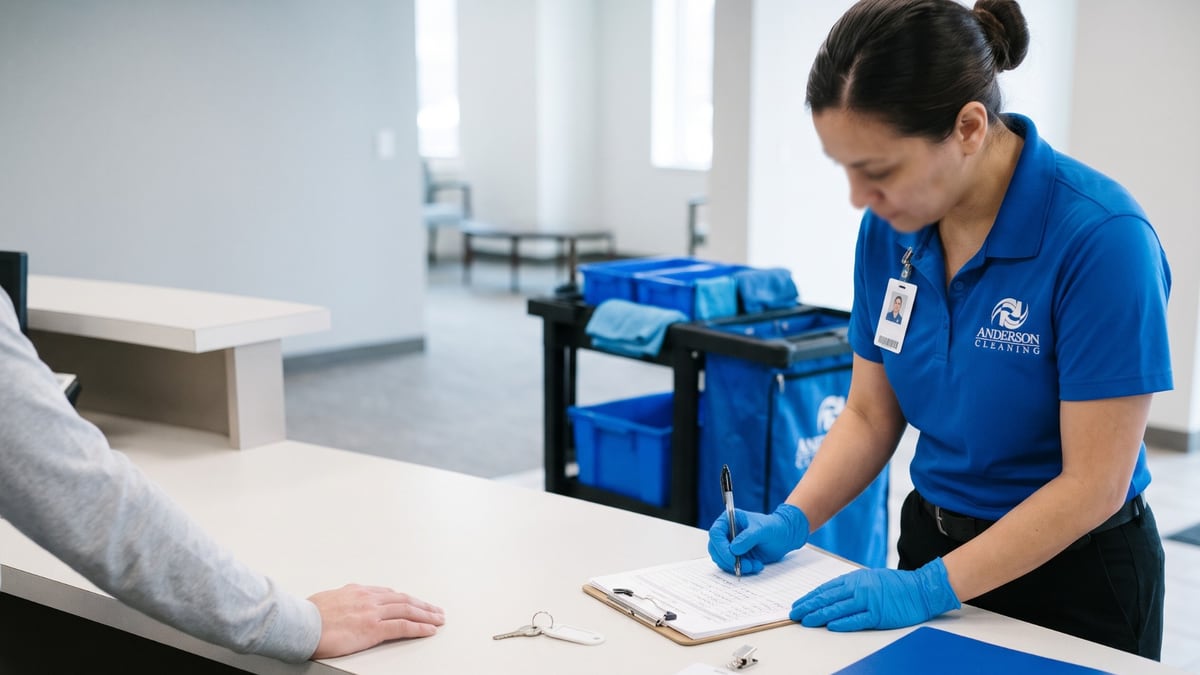
Every key, badge, fob, and alarm code is listed, returned, and reissued against a written list. Before the transition, list every key, badge, fob, and alarm code the outgoing vendor holds, and name the person on each side who signs for their return. On the incoming side, issue credentials against the same kind of list and confirm who holds them. Give the incoming vendor its own alarm user code before its first visit, and have the outgoing vendor's code deactivated the morning after its last visit, so no code is reused and no night is uncovered.
Anderson Cleaning signs keys in and out, stores them securely, and tracks them, and coordinates alarm codes with the facility's security provider. Ask any vendor to describe its key-control procedure in the same detail, and have the facility's own access log record the changeover date. In healthcare and life-sciences support spaces, the privacy and restricted-area rules the crew must follow are confirmed before the first visit, not after.
What about supplies and equipment in the janitor closet?
Walk the closet with each vendor in turn, against the same written inventory: with the outgoing vendor before its last visit, and with the incoming vendor at onboarding. Separate what the facility owns from what the outgoing vendor owns, and write down the consumables on hand: paper products, soap, liners, hand sanitizer, and any products the facility purchased itself. If the outgoing vendor will not attend, inventory the closet with the incoming vendor and your own staff, photograph the shelves, and send the list to the outgoing vendor in writing. The outgoing vendor removes its equipment and its chemicals, with safety data sheets going with them. The incoming vendor brings its own, with safety data sheets for every product it will use on site available to the facility.
If the outgoing vendor installed proprietary dispensers, settle whether they stay, who refills them, and whether the incoming vendor's products fit them. If supply management is part of the new program, the supply management page describes how par levels and reorder points are set and recorded, and those are confirmed during the first visits.
What should the first week look like?
The first week establishes the routine the building will run on, so it is supervised more closely than any other. Before the new crew works alone, each member receives site-specific instruction: where supplies are stored, which areas carry privacy or access rules, which products are approved for which surfaces, and what the facility manager cares about most. The site supervisor is on site for the first visits, walks the scope with the crew, and signs the inspection log from the first night.
Expect the first inspection logs to carry notes rather than a clean sheet. The new crew will find conditions the old program left, such as finish wear in a corridor, a dispenser that does not close, or a storeroom with no light. Those belong in the log as facility conditions reported, so the facility manager sees them in writing and decides what to do.
Tell occupants what is changing. A short notice that a new cleaning crew starts on a given date, wears a company uniform and any badge the facility issues, and can be reached through the facility office prevents the first night's crew from being mistaken for strangers in the building.
How is the first quality review set?
Its date is confirmed at onboarding, before the first visit, from the review schedule written into the proposal. The first quality review is a scheduled walk-through where the site supervisor and the facility manager compare each area against the written scope and record what will change. Setting its date during onboarding gives both sides a fixed point to measure the first weeks against, rather than waiting for a complaint. The post on what a quality review walk-through covers explains the agenda and how findings are recorded and closed.
After the first review, quality reviews continue on the schedule agreed in the service plan, and the inspection log becomes the record between them.
What goes on a transition checklist?
Eight items, each settled before the incoming vendor's first visit:
- Notice clause read, end date calculated, and the new start date agreed before notice is given
- Walk-through done, scope written as tasks by cadence, and insurance certificates exchanged
- Last and first visits on consecutive service days, with any difference in service days covered in writing
- Keys, badges, fobs, and codes listed, returned, and reissued; outgoing alarm code deactivated, incoming code issued before the first visit, and any door with an unreturned key rekeyed
- Closet inventoried, ownership of supplies and dispensers settled, safety data sheets on site
- Site-specific instruction for the new crew, supervisor present for the first visits
- Occupants told the date, the uniform they will see, and whom to contact
- First quality review dated at onboarding
Anderson Cleaning begins every new account with a walk-through and a written scope, assigns a dedicated site supervisor, and writes the quality review schedule into the proposal. Request a proposal and we will plan the transition dates with you before any notice goes out.
Sources
Need Professional Cleaning Services?
We handle critical cleaning for offices, healthcare facilities, and life sciences environments across Western MA and Northern CT. Get a custom proposal built for your facility.
Request Proposal